A2A Connect logo
A2A Connect
Blog
Start free trial
A2A Connect
© A2A Connect 2026. All rights reserved.
< All posts

How to Co-Broker a Property Deal in Dubai as a Licensed Agent (2026 Step-by-Step Guide)

Discover how to co-broker a property deal in Dubai as a licensed agent with our comprehensive 2026 step-by-step guide for success.

·Updated October 22, 2026·15 min read
How to Co-Broker a Property Deal in Dubai as a Licensed Agent (2026 Step-by-Step Guide)

how to co-broker a property deal in Dubai as a licensed agent | updated October 2026 | A2A Connect Editorial Team | 2-6 weeks per deal | Beginner

What You'll Learn

Co-brokering can feel like a gamble the first time you try it, but it is one of the most reliable ways to win deals in Dubai. This guide walks you through how to co-broker a property deal in Dubai as a licensed agent in 2026. You will learn which RERA forms matter, how the Dubai Land Department (DLD) expects commissions to be split, and how to find a trustworthy partner. Co-brokering, also called agent-to-agent (A2A) collaboration, lets a listing agent and a buyer's agent from two different brokerages work the same transaction and share the commission under a legally binding RERA agreement.

  • Understand the RERA forms, specifically Form A and Form I, that legally govern commission splits in co-brokered deals.
  • Learn why the standard commission split between cooperating agents is typically 50/50.
  • Discover where to find verified, RERA-registered agents for co-brokering opportunities outside your own brokerage.
  • Identify strategies to avoid common co-brokering disputes and protect your commission.

Prerequisites: an active RERA Professional Practice Card (Broker Registration Number, or BRN), sponsorship by a DLD-registered mainland brokerage, and access to the Trakheesi or Dubai REST system.


Why Co-Brokering Matters in Dubai Real Estate in 2026

Dubai's property market runs on cooperation. Buyers often work with one agent while the seller has listed with another, and the two agents need a way to work together. PropertyFinder's commission guide confirms that all agents involved must be registered with DLD, and the commission is often split 50:50 once more than one broker contributes to closing the deal. If you don't have a large personal database yet, co-brokering is often the fastest route to your first commission, giving you access to listings and buyer pools beyond your own brokerage.

The catch is risk. Industry guidance for UAE agents warns that agents sometimes proceed on trust or a phone call when time is short. A verbal commission split is not enforceable under RERA regulations, leaving the unprotected agent exposed if a dispute arises. Signing the right form at the right moment is what separates a smooth 50/50 split from a commission fight.

Enforcement has also tightened. RERA certification guidance notes that you can verify any agent's status on the Dubai REST app using their BRN number, and you should do that before agreeing to work on any listing. For supporting data, see Real estate market in Dubai in autumn 2022.


Got a buyer or an off-market listing?

Match requirements and listings privately with fellow Dubai agents on A2A Connect, and close the deal faster.

Start free trial

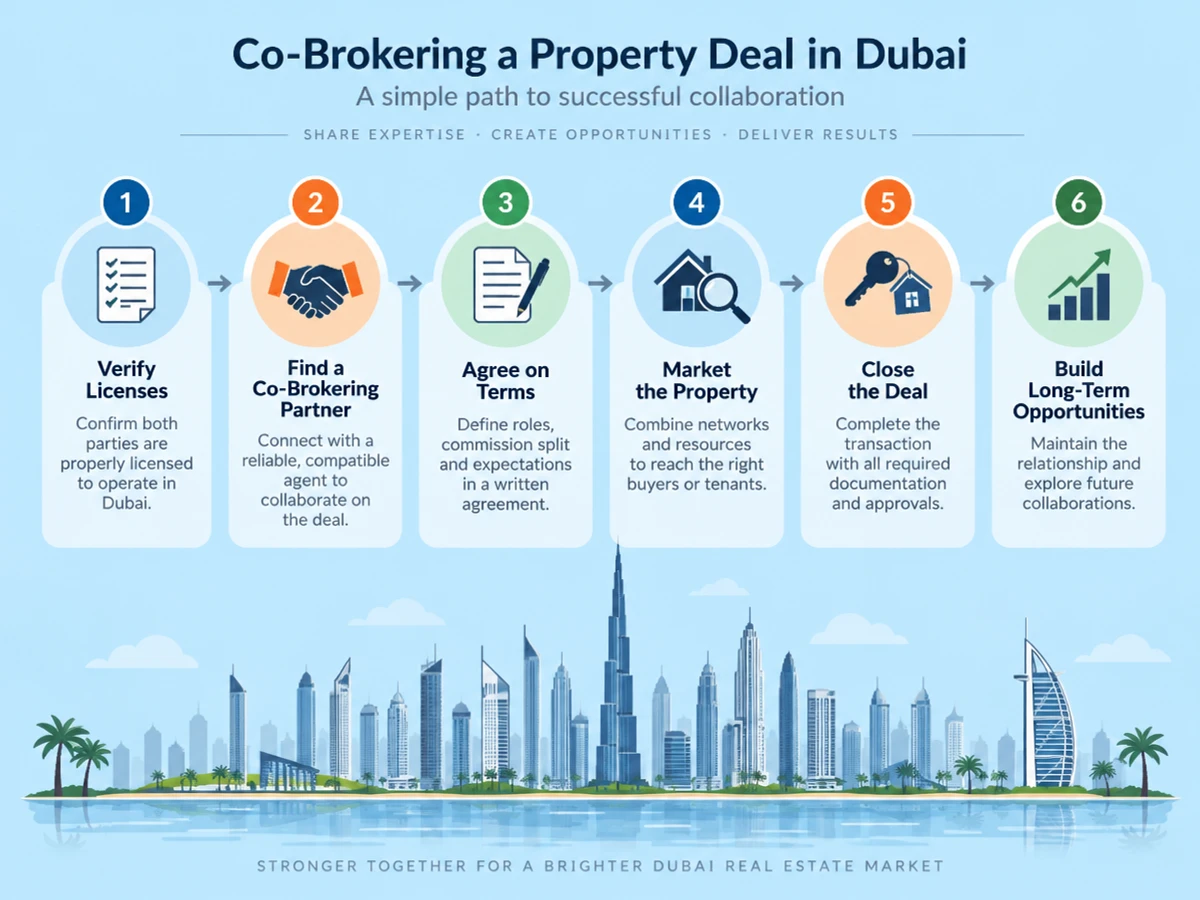
The Process at a Glance

StepActionTime RequiredOutcome
1Confirm your RERA license and BRN are active1 dayLegal eligibility to co-broker confirmed
2Find a verified co-broking partner agent1-3 daysMatched listing or buyer identified
3Sign RERA Form I agent-to-agent agreementSame dayCommission split legally secured
4Coordinate viewings, offer, and closing2-6 weeksDeal moves to signed sale contract
5Split commission and file closing paperwork1-2 weeks post-closingBoth agents paid, deal fully closed

Total time: most co-brokered deals in Dubai close within 3 to 9 weeks from first contact to commission payout, depending on financing and title transfer timelines.


Step 1: Confirm Your RERA License and BRN Are Active

What You're Doing

Your own paperwork comes first. Before you approach anyone, make sure your Professional Practice Card is valid and that a DLD-registered mainland brokerage sponsors you. A lapsed or unlicensed agent can void the commission agreement entirely, and your partner will notice.

How to Do It

  1. Open the Dubai REST app or your brokerage's Trakheesi dashboard and confirm your Broker Registration Number (BRN) is active, not expired or suspended. The BRN is the unique number RERA, the Real Estate Regulatory Agency, issues to licensed brokers in Dubai.
  2. Check that your sponsorship is current. RERA certification requirements state that agents must be sponsored by a mainland, RERA-licensed brokerage, since free zone company visas do not qualify. RERA is the regulatory arm of the Dubai Land Department (DLD), which oversees all real estate transactions, regulations, and registrations in Dubai.
  3. Confirm you have no outstanding violations. Guidance on Dubai's digital broker infrastructure warns that contacting a property owner who is not registered on the Green List is a violation, and a complaint can lead to suspension. Check this before you co-broker any listing sourced outside official channels.
  4. If your card has lapsed, renew it before you go further. Licensing cost guidance puts the total for an individual agent at roughly AED 6,000 to AED 12,000, covering DREI training, the RERA exam, and the broker card registration fee.

Common Mistakes

Many agents assume a brokerage trade license is enough on its own. It isn't. 2026 licensing guidance confirms that every real estate agent in Dubai must operate under a licensed brokerage, and true independent operation is not allowed under RERA regulations.

What Done Looks Like

You can pull up your BRN on Dubai REST, see an active status with no violations flagged, and confirm that your sponsoring brokerage's trade license is current. For a more detailed walkthrough, see How to Obtain a Real Estate License in Dubai, UAE.


Step 2: Find a Verified Co-Broking Partner Agent

What You're Doing

This is where most newer agents get stuck. You need a licensed agent outside your own brokerage who holds a matching listing or a qualified buyer, and you must confirm they are legitimate before any client details change hands.

How to Do It

  1. Define exactly what you need: a specific unit type, community, budget range, or a ready buyer with proof of funds.
  2. Use a dedicated agent-matching platform instead of cold outreach. A2A Connect is built for this purpose. It is a network for real estate agents in Dubai that helps match listings and client requirements with other licensed agents.
  3. Before sharing any client details, verify the partner's BRN on Dubai REST. RERA certification guidance confirms you can check any agent's status with their BRN number.
  4. Agree on the headline terms, including the commission split and who introduces whom, before you move on to paperwork.

Best Practices

  • Choose platforms with a vetted agent community over public social media groups. Impersonation and fake "agents" come up again and again in the Dubai market.
  • Keep a short list of 3 to 5 trusted co-broking partners in each community you specialize in. Repeat partnerships close faster than one-off matches.

Example

ScenarioAgent AAgent B
RoleListing agent, 3-bed villa in Dubai Hills EstateBuyer's agent, ready buyer at matching budget
How matchedListed the unit on A2A ConnectSearched buyer requirements on A2A Connect
Next stepBoth sign Form I before any viewing is arrangedBoth sign Form I before any viewing is arranged

What Done Looks Like

You have a specific, licensed partner identified, their BRN verified, and headline terms agreed on the commission split before any client is introduced.

Key Takeaway: Define your needs, use a dedicated matching platform such as A2A Connect, verify the partner's BRN on Dubai REST, and agree on headline terms before any client details or paperwork change hands.


Step 3: Sign the RERA Form I Agent-to-Agent Agreement

What You're Doing

This is the step that protects your money. Form I is the single document that makes a co-brokered commission split legally enforceable in Dubai, and skipping it is the most common cause of agent-to-agent disputes. Two licensed brokers from different agencies sign it when they work on the same transaction.

How to Do It

  1. Confirm the listing already has a valid Form A and Trakheesi permit. RERA forms guidance explains that Form A is the official listing agreement between seller and agent. Once signed, the agent uploads it to Trakheesi, which generates a permit number. Without that number, the home cannot be legally marketed.
  2. Draft Form I with both agents' names, brokerage details, RERA registration numbers, and the listing's permit number.
  3. Spell out the commission split. RERA forms documentation notes that the agreement names the property, both agents and their RERA details, the commission split (typically 50/50 of the total commission), and confidentiality obligations around client information.
  4. Sign Form I before arranging any viewing. The same guidance is clear that Form I applies when a buyer's agent finds a suitable property listed by another agent. Both agents must sign before either arranges viewings, shares details, or joins negotiations.

Common Mistakes

Proceeding on a handshake because the buyer is "ready now" is the costliest mistake in co-brokering. Industry guidance puts it bluntly: without Form I, the listing agent risks the buyer's agent approaching the buyer directly and cutting them out of the commission. The buyer's agent, in turn, risks the buyer going back to the seller independently.

What Done Looks Like

You and your partner both hold a countersigned Form I that references the correct Trakheesi permit number, and no viewing has taken place yet.

Key Takeaway: Confirm the listing has a valid Form A and Trakheesi permit, draft Form I with full details and an explicit 50/50 split, and sign it before any viewing or introduction.


Step 4: Coordinate Viewings, Offer, and Closing Together

What You're Doing

Once Form I is signed, the deal moves from paperwork to people, and the two agents must act as one team. The Memorandum of Understanding (MOU), also known as Form F, is the legally binding agreement the buyer and seller sign once an offer is accepted. It sets out the terms of the sale and secures the deposit.

How to Do It

  1. The listing agent arranges viewings and relays feedback, while the buyer's agent handles the buyer's financing and documents in parallel.
  2. Both agents negotiate the offer together and copy each other on all written communication. That record is your best defense if anyone later asks who did what.
  3. Once the offer is accepted, the buyer and seller sign the MOU (Form F) and pay the deposit. Both agents should keep a copy.
  4. Track the file through to the DLD trustee office for transfer, and confirm mortgage clearance or NOC where relevant.

Best Practices

  • Set a weekly check-in with your partner until closing. Silence between agents is the most common reason a deal falls apart mid-transaction, usually because each side assumes the other is handling something.
  • Keep every client-facing update consistent across both agents so the buyer and seller never receive conflicting information.

What Done Looks Like

The MOU is signed, the deposit has cleared, and the transaction is booked for title transfer at the DLD trustee office, with both agents aware of the appointment date.


Step 5: Split Commission and Close Out the Paperwork

What You're Doing

The deal is not finished until the money is split correctly. Once title has transferred, you handle invoicing, VAT compliance, and the division of the commission exactly as Form I describes.

How to Do It

  1. Confirm the final commission against the rate stated in Form A. RERA forms guidance notes that broker's commission is commonly 2% of the sale price for resale transactions.
  2. Apply VAT correctly. Commission invoices in Dubai are subject to 5% VAT, no matter how the fee is split between agents.
  3. Each brokerage invoices its own share directly, as recorded in Form I. Avoid having one agent collect the full fee and pass it along informally, which is where trust quietly breaks down.
  4. File the signed Form I and transaction records with your brokerage for at least the retention period your compliance team requires.

What Done Looks Like

Both brokerages have invoiced and received their agreed share, and the signed Form I is archived with the closed transaction file.


What to Do After Closing a Co-Brokered Deal

Within the first 30 days, ask your partner for a short debrief on what worked and what slowed things down. If the collaboration ran smoothly, keep them on your trusted partner shortlist.

Over the next 90 days, focus on repeat relationships rather than one-off matches. Agents who co-broke successfully once often transact together again within a quarter, especially when they source deals through a consistent platform like A2A Connect.

Over the longer term, track co-brokered deal volume separately from solo deals to see which communities and price bands benefit most from partnerships, then widen your partner network in those areas.


Resources You'll Need

ResourceRoleRequirement LevelCost
A2A ConnectFinds and matches verified co-broking partner agents in DubaiRecommendedContact for pricing
Dubai REST AppVerifies agent BRN status and manages permitsRequiredFree
RERA Forms Guide (Form A, B, I)Reference for required co-brokering paperworkRequiredFree
Commission and VAT GuidanceConfirms commission split and VAT compliance rulesRecommendedFree
DREI-approved broker training providerMaintains active RERA certification and renewalRequiredAED 3,200-5,500

See also, see Real Estate Success Tips for Dubai Brokers | PDF | Sales.


Common Plateaus & How to Break Through

Problem: Your co-broking partner goes silent after the first viewing

Likely cause: No check-in schedule was agreed, so updates stop once interest cools.

Fix: Set a fixed weekly update time in writing when you sign Form I.

Problem: A dispute arises over who actually introduced the buyer

Likely cause: The agents moved ahead informally before signing Form I. This is exactly the situation RERA guidance warns about, where a verbal split is unenforceable.

Fix: Never arrange a viewing before Form I is signed and dated, however urgent the buyer seems.

Problem: You cannot find a matching listing or buyer outside your own brokerage

Likely cause: Relying only on personal contacts or public social media groups keeps you in a small, repetitive pool of agents.

Fix: Use a dedicated matching platform such as A2A Connect, which helps agents share, match, and close deals through a vetted agent community.

Problem: Commission payment is delayed after closing

Likely cause: The split was agreed verbally rather than written into Form I, so accounting teams are unsure how to invoice.

Fix: Record the exact percentage, payment timeline, and invoicing party in Form I at signing.

Key Takeaway: Most co-brokering headaches come from skipping steps. Set a communication rhythm, sign Form I before any client contact, use a dedicated matching platform, and write every split term into the agreement. For more troubleshooting advice, see Mistakes Brokers Make: Common Pitfalls and How to Avoid ....


Conclusion

Learning how to co-broker a property deal in Dubai as a licensed agent comes down to four habits: confirm your own license, find a verified partner, formalize the split with Form I before any client contact, and keep communication steady through closing. Agents who treat co-brokering as a structured process close more deals with fewer disputes.

Key Takeaways

  • A properly executed co-brokered deal in Dubai typically splits commission 50/50 between the listing agent and the buyer's agent, formalized through RERA's Form I.
  • Form I, not a verbal agreement, is what makes the split legally enforceable. Sign it before any viewing or introduction.
  • Your next move should be checking your own BRN status, then finding a verified partner through a platform such as A2A Connect before your next listing or buyer inquiry comes in.

FAQ

How do you co-broker a property deal in Dubai as a licensed agent in 2026?

Start by confirming that your RERA Professional Practice Card (BRN) is active and that your brokerage is DLD-registered. Next, find a verified partner, often through a matching network such as A2A Connect, and sign RERA's Form I agent-to-agent agreement before any viewing, specifying the commission split (usually 50/50). Both agents then run viewings, the offer, the MOU, and title transfer together, and each brokerage invoices its agreed share once the deal closes.

What is Form I and why is it required for co-brokering in Dubai?

Form I is the RERA agent-to-agent agreement that two licensed brokers from different agencies sign when they work on the same transaction. RERA forms documentation confirms that it governs the relationship between two agents on the same deal, one representing the seller and one representing the buyer. It sets out how they will collaborate, share information, and divide the commission.

What is the standard commission split for co-broked deals in Dubai?

The usual split is 50/50 between the listing agent's brokerage and the buyer's agent's brokerage, as documented in Form I. The figure is negotiable, and it must be written into the agreement rather than assumed.

Can I co-broker a deal without signing Form I?

No. Agents sometimes proceed informally when time is tight, but that leaves the commission split unenforceable. Either agent can be cut out of the deal entirely if the other goes straight to the client.

How do I find a co-broking partner agent in Dubai?

The most reliable route is a dedicated agent-matching platform built for the Dubai market, such as A2A Connect. It connects Dubai's real estate agents through a digital network so they can share, match, and close deals, instead of relying on informal contacts or public social groups.

Do I need a RERA license to co-broker a property deal in Dubai?

Yes. Every agent in a co-brokered deal must hold an active RERA Professional Practice Card and be sponsored by a DLD-registered mainland brokerage. Working without this certification is illegal in Dubai, and it exposes both agents to fines and possible license revocation.

How long does a co-brokered deal take to close in Dubai?

Most co-brokered resale deals close within 3 to 9 weeks from the first introduction to commission payout. The timeline depends on buyer financing, NOC processing, and title transfer scheduling at the DLD trustee office.

What happens if a dispute arises between two co-broking agents?

If both agents signed Form I with clear commission terms, the agreement is enforceable and disputes can go through RERA's channels. If the deal rested on a verbal agreement, the unprotected agent has little recourse. That is why signing Form I before any client contact is non-negotiable.

This guide was compiled from current RERA and Dubai Land Department form requirements, licensing guidance, and commission-structure reporting available as of October 2026. Commission rates, form requirements, and licensing costs change over time, so always confirm current terms with your sponsoring brokerage and RERA's official channels before you finalize any agreement.

Got a buyer or an off-market listing?

Match requirements and listings privately with fellow Dubai agents on A2A Connect, and close the deal faster.

Start free trial
Social Share
Add as a preferred source on Google
Social Share
Add as a preferred source on Google
A2A Connect logoA2A Connect

Close more deals. 10x your viewings.

Share listings privately with fellow Dubai agents and get matched to the right buyers and requirements.

Start free trialVisit a2aconnect.ai