real estate agent cooperation rules and commission splits in Dubai 2026 | updated October 26, 2026 | 9 min read | A2A Connect Editorial Team
Real Estate Agent Cooperation Rules and Commission Splits in Dubai 2026
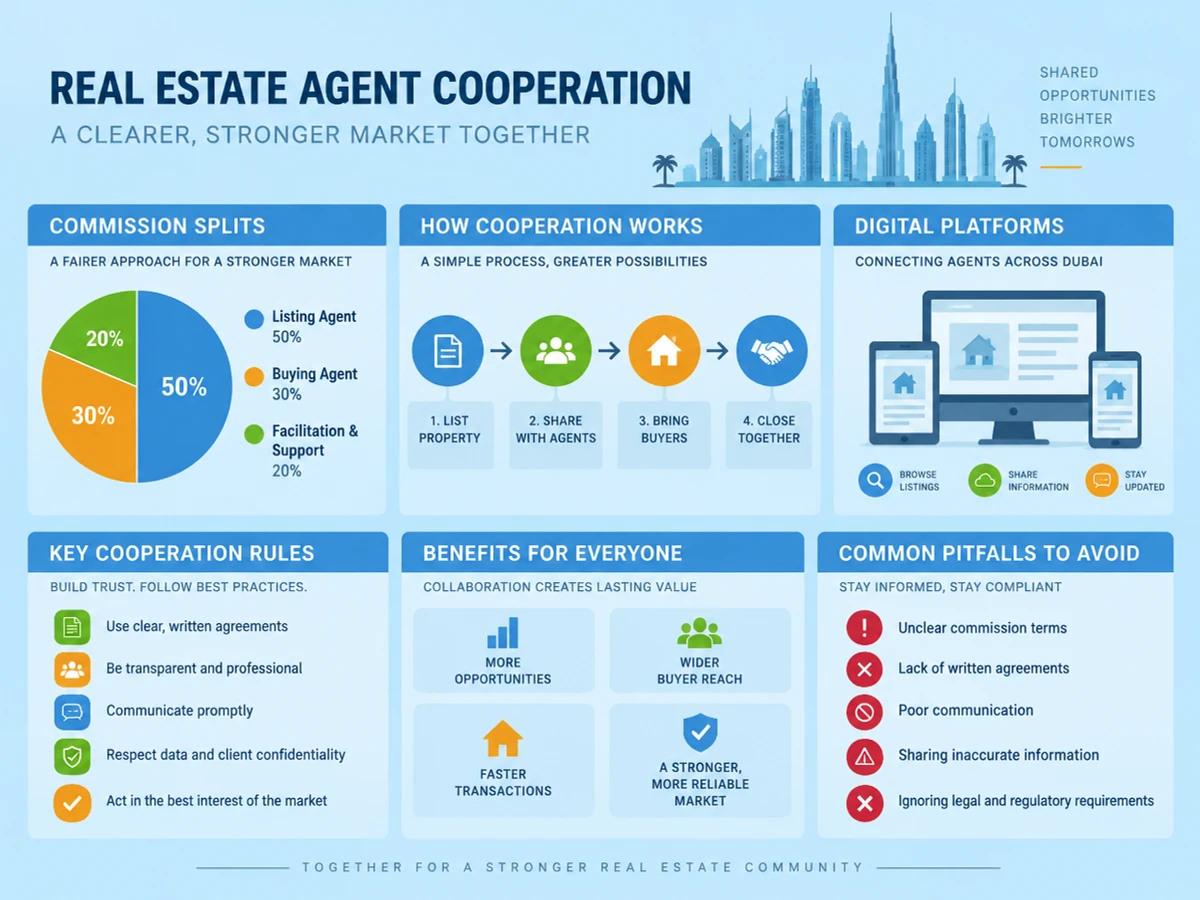
Real estate agent cooperation rules and commission splits in Dubai 2026 are governed primarily by Dubai Land Department (DLD) Law No. 85 of 2006. The law requires any cooperating broker to hold a valid RERA registration and to document commission arrangements on standardized forms before a deal closes. When two agencies work together on a transaction, the brokerage commission is typically split 50/50. Each agent's share of their own agency's half ranges from 40% to 80% depending on seniority. Unregistered cooperation, or undocumented commission agreements, can leave an agent with no legal claim to their share if a dispute arises.
This guide covers the RERA forms that make co-broking enforceable, how splits are calculated between agencies and between agents and their brokerage, and where most compliance failures occur. It also examines how digital matchmaking platforms are changing agent-to-agent deals in Dubai's competitive brokerage market.
In a market where 39,776 active licensed brokers collectively earned AED 13.736 billion in commissions from over 215,000 transactions last year, agents who understand cooperation rules tend to close more deals, not fewer. They can partner across brokerages with confidence, without worrying about losing their share.
What Are the Official Agent Cooperation Rules in Dubai Real Estate?
Dubai's cooperation framework rests on Law No. 85 of 2006. It entitles any registered broker to compensation if they contributed to closing a sale or lease, whether they worked alone or alongside another agency. The Dubai Land Department and its regulatory arm RERA require every practising broker to hold an individual licence card with a registered broker number. Clients can verify that number through the Dubai REST app. The Dubai REST app is the official real estate platform where agents register listings and clients check licences.
Who Can Cooperate on a Listing
DLD rules treat rental and sales listings differently when it comes to how many brokers can represent a single unit.
- Rental listings: Multiple agents can represent the same rental property at the same time, with no limit on the number of brokers.
- Secondary market sales: No more than three agents can formally represent a single resale property at once, keeping accountability clear.
- Registered contracts required: When several brokers work the same listing, the client must sign a contract with each broker, registered with the Dubai Land Department. That registration is a prerequisite for any commission claim.
- Named agents and property details: Every cooperation contract must specify the participating agents, the property details, and the conditions under which services are provided.
Key Takeaway: Agent cooperation is legal and encouraged under DLD rules, but it protects your commission only when the listing, participating agents, and fee terms are formally registered before the deal moves forward. For deeper context, see Dubai Real Estate Commission: Splits, VAT & RERA Forms.
How Are Commission Splits Structured Between Cooperating Agents in Dubai 2026?
Commission splits operate on two layers: the split between cooperating brokerages on a single deal, and the internal split each agent receives from their own agency. Most co-brokered transactions default to a 50/50 division between agencies, while the individual agent's cut of their agency's half depends on track record and tenure.
Agency-to-Agency Splits
When a buyer's agent and a seller's agent from different brokerages close a deal, the combined commission (usually 2% of the sale price on resale transactions) is divided evenly unless the parties agree otherwise. Co-brokerage structures in Dubai typically see the buyer pay their agent 2% and the seller pay theirs 2%. Each side is financially accountable only to the client they represent.
Agent-to-Agency Internal Splits
Once an agency receives its share, it splits that amount again between the individual agent and the brokerage. The table below shows typical splits across experience tiers.
| Broker Experience Level | Typical Internal Split (Agent/Agency) | Approx. Annual Deal Volume Driver | Notes |
|---|---|---|---|
| New broker (0-2 years) | 40% / 60% | Low to moderate | New brokers typically keep 40% to 50% of generated commission |
| Mid-level broker (2-5 years) | 50% / 50% to 60% / 40% | Moderate | Most common split tier in Dubai agencies |
| Senior/top performer (5+ years) | 60% / 40% to 70% / 30% | High | Unlocked after crossing agency revenue thresholds |
| Desk-fee / independent model | Up to 100% / 0% | Very high | Agent pays a flat desk fee instead of a percentage split |
Take a representative AED 3 million villa resale. A 2% agency commission generates AED 60,000 gross. On that AED 60,000 gross fee, the agent takes home AED 30,000 under a standard 50/50 internal split, while the brokerage keeps the rest to cover marketing and overhead.
"Never accept a 50/50 split without verifying exactly how many verified portal leads and marketing credits the agency commits to in writing each month," notes one Dubai brokerage commentary on commission structures. The split percentage alone rarely tells the full story of an agent's earning potential.
Key Takeaway: Dubai's commission system has two layers, agency-to-agency and agent-to-agency. Both need to be documented and understood before an agent commits to a co-brokered deal, which also makes weak offers easier to spot. For deeper context, see Real Estate Agent Commission Dubai: Rates, Law, Who Pays.