why Dubai property deals fall through and how agent networks stop it | 9 min read | A2A Connect Editorial Team
Why Dubai Property Deals Fall Through in 2026 and How Agent Networks Stop It
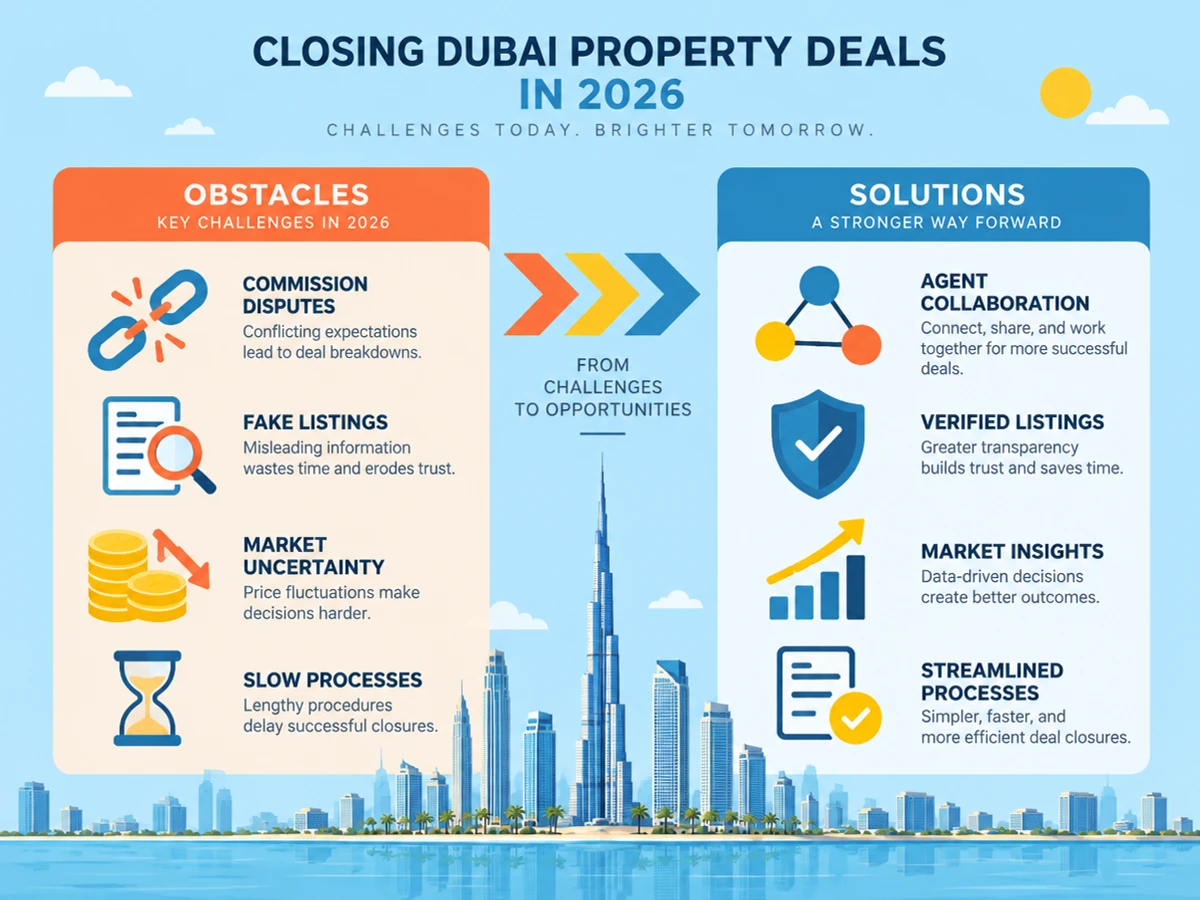
Most Dubai property deals that collapse in 2026 do so for one of three structural reasons: listings that cannot be verified or appear more than once, commission disputes between competing agents, and communication scattered across WhatsApp threads with no record of who represents whom. Transaction volume has hit record highs, but the infrastructure linking agents has not kept pace. The result is wasted viewings, stalled MOUs, and avoidable disputes, which licensed-agent networks like A2A Connect are built to prevent.
Dubai's property market processed AED 252 billion in transactions during Q1 2026 alone, a 31% year-on-year increase in value, according to the Dubai Land Department. That growth has brought more agents, listings, and cross-agency deals than informal coordination tools were designed to handle. Phone calls, scattered WhatsApp groups, and unverified portal ads were built for a smaller market.
A deal that survives the viewing stage in Dubai can still collapse at the MOU, not because the buyer changed their mind, but because nobody could confirm who actually controlled the listing, who was owed commission, or whether the "exclusive" was real.
Why Do Dubai Property Deals Fall Through in 2026?
Dubai property deals tend to fall through in 2026 for three main reasons: listing integrity gaps, commission and co-broking disputes, and buyer qualification failures. These problems usually surface only after time and resources have been spent, and they are recurring patterns across the agent community.
The Three Recurring Failure Points
- Listing integrity: Properties get advertised without a valid Trakheesi permit, or the same unit appears across multiple portals with conflicting prices, making buyers distrust the listing before an agent calls back.
- Commission and representation conflicts: Two agents both claim to represent the same buyer or seller, triggering disputes over who is owed commission once the sale closes.
- Buyer qualification gaps: Agents spend days on viewings with buyers who were never going to transact, due to budget mismatch, missing visa status, or unconfirmed financing.
Why This Is Worse in a Record-Breaking Market
Dubai's own success is part of the problem. Industry data shows that buyers routinely message between four and eight agents at the same time about a single property. That multiplies the odds of duplicate representation and commission confusion long before a contract is drafted. With 60,303 total real estate transactions recorded in Q1 2026 alone, the number of agents touching each deal has outpaced the systems meant to coordinate them.
Key Takeaway: Deals rarely fall apart because of buyer hesitation alone. They fall apart because the infrastructure connecting agents, listings, and buyers is still manual, duplicated, and hard to verify at scale. The first place this shows up is the listing itself. For deeper context, see Dubai Off-Plan Market Set to Boom in 2026: Key Investor ....
Fake and Duplicate Listings: The Verification Problem Killing Deals
Fake and duplicate listings remain one of the most common reasons Dubai property deals stall before an offer is made, despite the Dubai Land Department's Trakheesi permit system, which exists to prevent them. Buyers who encounter conflicting prices or unverifiable listings simply disengage, and agents lose the deal before negotiations begin.
What Trakheesi Was Built to Stop
The Trakheesi permit system was specifically designed to combat fake listings. It requires every property advertisement in Dubai to carry a valid permit number tied to a verified title deed or Ejari record. Even so, comparisons of Dubai's major listing portals still find that the same villa can appear with 15 different photos and three different prices, all from different brokers. In June 2026, Dubai Police confirmed that fraudsters still copy genuine property listings and repost them at artificially low prices to trap buyers who skip verification.
How Verification Failures Translate Into Lost Deals
| Listing Problem | Effect on the Deal | Verification Step Buyers Now Expect |
|---|---|---|
| No Trakheesi permit number | Buyer assumes the listing is illegal or scam bait and walks away | Check permit on the DLD Trakheesi portal before engaging |
| Duplicate listing, multiple prices | Buyer distrusts the seller's price point and the agent's credibility | Cross-check against actual DLD transaction data |
| Copied listing at a lower price | Buyer wires a deposit to a fraudulent party, deal never existed | Verify via Dubai REST app and Madmoun QR code |
| Unlicensed agent marketing the unit | Deal is legally unenforceable once discovered | Confirm RERA/BRN status via Dubai REST before any MOU |
- Madmoun QR verification: Since April 2023, DLD has required every advertisement to display a Madmoun QR code alongside its Trakheesi permit number, giving buyers an instant way to confirm a listing is real.
- Portal cooperation: Major portals including Dubizzle, Property Finder, and Bayut work with DLD and remove non-compliant listings once flagged.
- Agent-side cost: Every hour spent chasing a duplicated or unlicensed listing is an hour not spent on a deal that can close.
Key Takeaway: Verification exists at the regulatory level through Trakheesi and Madmoun. The agent-to-agent layer is still largely manual, and that is where the gap remains: confirming which licensed agent genuinely holds the mandate on a listing. A closed network of verified, licensed agents such as A2A Connect closes that gap by matching listings and requirements only within a vetted community. Even a verified listing can fail once two agents claim the same client, which is where commission disputes begin.